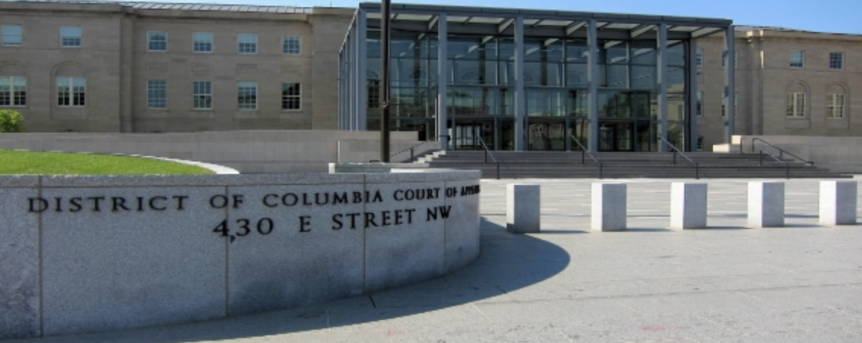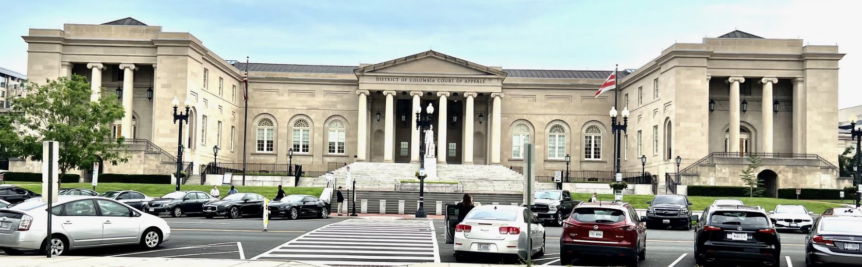
The D.C. Court of Appeals has struck down as unconstitutional the District’s ban on high capacity magazines for firearms. Specifically, the court found recently in Benson v. United States, 2026 D.C. App. LEXIS 80, that the prohibition against magazines capable of holding more than 10 rounds of ammunition – what the court refers to as 11+ magazines – violates …
Defining “malice” in destruction of property case in D.C.
Roman Wiley (aka Kamaal Mumin) believed he owned a particular house in D.C. This, as it turns out, was a delusion. The real owner, who was renovating the property, kept finding Wiley on the property. At one point, Wiley changed the locks on a wrought-iron gate securing a back door. He did this by unfastening the two screws that kept …
On threats and the attorney-client privilege in Moore
The “attorney-client privilege” protects confidential communications between a client and their attorney. As an exception to the general rule that all relevant facts should be available in the truth-seeking process, the purpose of the privilege is to encourage clients to be open and honest with their lawyers. The privilege belongs to the client, not the attorney. It can cover oral, …
The “voluntary intoxication” defense in D.C.
According to recent opinion issued by the D.C. Court of Appeals, Darrell Jones v. United States, __ A.3d __ (D.C. 2025), the defense must prove “incapacitating intoxication” in order to negate the mens rea element of a criminal offense. ***** “Voluntary intoxication” is generally not a viable defense to a criminal charge in Washington, D.C. As Joshua Dressler puts it …
D.C.’s new sealing/expungement law needs fixing
[Update: D.C. Council resolved the problems described below through the “Peace DC Omnibus Emergency Amendment Act of 2025.”] There are major problems with D.C.’s new criminal record sealing/expungement statute. D.C. Code § 16-801 et. seq. For example, according to one reading of the statutory language, a person charged with a violent felony can seek immediate relief through a motion …
Editorializing about Miranda rights in Green v. U.S.
Although police officers are not required to read the Miranda rights verbatim, any editorializing risks confusing the suspect, thereby nullifying the warning.
Storming the Capitol in Larson-Olson v. U.S.
It was hard to argue that there was insufficient evidence to convict Larson-Olson of unlawful entry when recordings showed defendant struggling with police.
On 4th Amendment seizures and abandoned property in U.S. v. Pope
When is a person seized for Fourth Amendment purposes? When is a piece of property abandoned such that there is no longer reasonable expectation of privacy?
Evans v. U.S.: More on the innocent possession of a firearm
According to the “innocent possession of a firearm” defense in D.C., it is permissible to use in self-defense what might otherwise be an unlawful firearm.
On the fumbling hand of counsel
According to the 6th Amendment, the lawyer who accepts representation in a criminal case must affirmatively assist with the defense, thereby advancing it.
On ineffective assistance of counsel in Dugger v. U.S.
A seasoned criminal defense lawyer was replaced by someone who had never before tried a criminal case. Not surprisingly, things did not go well for defendant.
The Alibi defense in D.C.
From the Latin for “elsewhere,” an alibi defense is based on the physical impossibility of a defendant’s guilt: the defendant could not have committed the crime because he or she was somewhere else at that same time.
On “offensive touching” assault in D.C.
The defendant “poked” the complainant somewhere on the body after having been specifically admonished not to do so. Such an “offensive touching” constituted a criminal assault.
The “Rule of Lenity” in D.C.
According to the “Rule of Lenity,” a court should construe any ambiguity in the language of a criminal statute in favor of the defendant.
On the “Claim of Right” Defense in D.C.
Although “claim of right” is a valid defense to robbery and other theft offenses, the defense fails when the defendant takes more than the property whose ownership is in question.
The “forfeiture-by-wrongdoing” doctrine in Hairston
Under the ‘forfeiture-by-wrongdoing doctrine, a defendant forfeits his Sixth Amendment right to be confronted by a witness against him, as well as his objection to the introduction of hearsay, if he wrongfully procured the unavailability of that witness with the purpose of preventing the witness from testifying.
Bias and corruption in Jones v. US
Bias can be “a favorable or friendly feeling toward a party.” It can also be hostility toward someone, a motive to lie out of self-interest, and/or corruption.
On Judicial Notice and Mejia-Cortez
Although a court may take “judicial notice” of commonly known facts, the government must still prove every element of a criminal offense beyond a reasonable doubt.
On the right to testify in Graves v. U.S.
It is reversible error for the trial judge to prohibit the defendant from testifying that he was acting in self-defense when the court had already concluded that the arresting officer had not used excessive force.
On the “missing evidence” jury instruction in Howard v. US
Like “reading the white space” on a police report (that is, focusing on what is NOT included), the “missing evidence” jury instruction “essentially creates evidence from non-evidence.”
Clearing/sealing/expunging a criminal record
Everything you need to know about clearing, expunging or sealing your criminal record in anticipation of background check for employment, adoption, immigration, volunteer opportunity or gun license.
Immediacy of response, not threat, in self-defense case
Words in the law do not always mean what their dictionary definitions say they mean. With respect to a prior consistent statement, for example, it is not really, as suggested by the rule, that such a statement must be offered to rebut a charge of “recent fabrication.” Instead, it is “only that the alleged contrivance be closer to the trial …
Judicial Notice: The Difference Between “Legislative” and “Adjudicative” Facts
A court accepts a well-known and indisputable fact without taking the time and trouble of requiring a party to prove it. What could be more straightforward, more commonsensical, than that? As McCormick puts it, the “oldest and plainest ground for judicial notice is that the fact is so commonly known in the community as to make it unprofitable to require …
Wayne LaFave on “Motive”
Motive. It is really big on TV shows. At the same time, if you listen to Wayne LaFave, it is completely irrelevant when it comes to substantive criminal law: The government is not required to prove motive in order to secure a conviction. The New Oxford American dictionary defines “motive” as “a reason for doing something, esp. one that is …
Actus Non Facit Reum Nisi Mens Sit Rea
Translated into English, actus no facit reum nisi mens sit rea means that “an act does not make one guilty unless his mind is guilty.” In other words, it is not enough for the government to prove a physical part of a crime; that is, an act or an omission to act. The government must also prove a mental part …
Jacobs v. United States: Narrowing the Definition of “Seizure” in D.C.
You are sitting in a legally parked car on the side of the road minding your own business when a police car pulls in directly behind you and activates its overhead lights. How many people would feel that they were perfectly free to drive away at this point? Anybody? Anybody at all? Because this is the standard for determining whether …
Refining the Definition of “Testimonial Evidence” under Crawford v. Washington
Police questioning results in “testimonial” evidence if the primary purpose of the interrogation is “to establish or prove past events potentially relevant to later criminal prosecution.”
The Duty to Disclose Includes the Duty to Preserve
Police officers fail to preserve a critical piece of evidence, in this case a video recording taken of the incident in question. The defendant moves for sanctions. In opposing this motion, the government argues that the defendant’s arguments about what the recording contained is speculative. The court agrees. Am I missing something here? Without the opportunity to have actually watched …
Why The Truth Doesn’t Matter At Trial
One of my favorite episodes from the old T.V. show “All In The Family” involved a situation in which an African-American repairman came to the Bunker household to fix a kitchen appliance. Archie Bunker, the right-wing bigot, and his leftist, hippie son-in-law each remembered the incident differently, and the show began with two flashbacks in which each man re-told the …
Do the Exclusionary Rules Deter Illegal Conduct?
McCormick on Evidence points out that you should avoid referring to “the exclusionary rule” in the singular: Discussions sometimes assume the existence of “the exclusionary rule,” suggesting that there is only one remedial requirement involved. This is unfortunate and misleading. Litigation and discussion is often dominated by considerations of the Supreme Court’s construction of the Fourth Amendment to the United …
On the Crucible of Cross-Examination
It happens perhaps most often in domestic violence cases that the complainant fails to show up on the morning of trial. The government would have you believe this is because the complainant fears for his/her safety, and this might sometimes be true. More often, it is because the complainant has reconsidered having the lover, spouse, or family member locked up …
Young v. U.S.: The Confrontation Clause Is Still Alive In D.C.
The U.S. Supreme Court has made such a mess of the Confrontation Clause line of cases that the D.C. Court of Appeals declared today that it really doesn’t know what to do. So it decided to do the right thing instead. In Robert Young v. United States, 63 A.3d 1033 (D.C. 2013), the D.C. Court of Appeals decided to essentially …
Further Guidance on Significant Bodily Injury in Quintanilla v. U.S.
The D.C. Court of Appeals took another step last week in defining what up until recently has been a poorly defined term: the “significant bodily injury” that is required in order for the government to prove felony assault. Although the appellant in Fidel Quintanilla v. United States, 62 A.3d 1261 (D.C. 2013), was convicted of multiple felony offenses, including robbery, …
Unlawful Entry, Criminal Contempt, Double Jeopardy, and Prior Bad Acts
When people talk about evidence being admitted at trial, they tend to think in terms of physical evidence: guns, drugs, documents, fingerprints, DNA, that type of thing. Sometimes you need to remind them that oral testimony alone – someone getting up on the stand and testifying to what he or she saw – can also serve as the basis for …
D.C. Court of Appeals on “Furtive Gestures”
Sometimes you need to go outside your own jurisdiction to find the right language in support of an argument. For years I have been looking for language that captures the problems — the ambiguity and the over-inclusiveness – posed by use of the police officer’s favorite catch-all phrase, “furtive gestures.” Today I found what is probably the best language I …
Constructive Possession: Intent Required, Not Just Proximity and Knowledge
That a controlled substance can be possessed constructively as well as actually is a court-made decision. As Judge Ruiz put it in her concurring opinion to Rivas v. United States, 783 A.2d 125 (D.C. 2005), the “doctrine of constructive possession is a judicially developed theory of liability designed to be a ‘proxy’ for actual possession.” The government needs to prove …
Lee v. United States: Mistaken Jury Instructions on the “Defense of Others”
The D.C. Court of Appeals was apparently feeling charitable. In Adrian Lee v. United States, 61 A.3d 655 (D.C. 2013), a decision issued last week, the Court bent over backwards to justify and explain mistaken jury instructions issued by the trial judge. Even as it reversed him. Adrian Lee was convicted of voluntary manslaughter and of carrying a dangerous weapon …
The “Quantum of Evidence” Needed to Corroborate a Confession
The “corroboration rule” requires the government to introduce “substantial independent evidence” establishing the trusthworthiness of a confession before that statement can be submitted to the jury.
Harrison v. U.S.: Reasonable Doubt Through Too Many “Interconnected Inferences”
Yes, they record your personal phone calls from prison. Yes, they have someone listen to those tapes. And, yes, they sometimes find something on those tapes to use against you. There is usually a voice recording that periodically reminds both parties — the inmate and the family member or friend he is speaking with – that the conversation is being …
Attempted battery assault is a “specific intent” offense
As recent D.C. case law demonstrates, the distinction between general and specific intent crimes is both simplistic and potentially misleading.
Consensual encounters and unprovoked flight under Henson v. U.S.
One of the problems with bad law is that it leads to even worse law. I have never been a big fan of the U.S. Supreme Court’s decision in Illinois v. Wardlow, which held that being in a “high crime” area (what part of any U.S. city does not have a lot of crime?) and running away at the sight …
Interpreting “Joint Constructive Possession” in Tamara Smith v. U.S.
If constructive possession is a legal fiction, then joint constructive possession is a double legal fiction.
What is a “Testimonial Statement” under Crawford v. Washington?
Crawford held that a “testimonial” statement can only be admitted if: (1) the government can prove that the witness was unavailable to testify, and (2) the defendant has had a prior opportunity to cross-examine that witness.
On bias, extrinsic evidence, and other matters in Longus v. U.S.
Bias is “the powerful distorting effect on human testimony of the witness’s emotions or feelings towards the parties or the witness’ self-interest in the outcome of the case.”
Myers v. U.S.: What is “knowing” possession of a firearm?
Previously convicted of a felony, Michael Myers was arrested while carrying a garbage bag that contained the disassembled parts of a shotgun. Was he guilty of being a felon in possession of a firearm?
Acta exteriora indicant interiora secreta
Today’s legal maxim is not particularly eloquent, in either Latin (acta exteriora indicant interiora secreta) or English (“outward acts indicate the thoughts hidden within”). But I include it today because it deals with intent, which is a key concept in criminal law. Men rea (or “state of mind”) is an element of most criminal offenses. And since the finder of …
Defining “Readily Available” in Clyburn v. U.S.
“Readily available” is defined in Washington, D.C. as being in close proximity or easily accessible during commission of crime of violence/dangerous crime.
Once Again, No Consequences for Prosecutorial Misconduct
On the morning of trial, the prosecutor finds out that the testimony provided by a police officer at the preliminary hearing was inaccurate. Although the prosecutor himself is not planning to call this particular police officer to testify at trial, he knows that the defense attorney is. So what does prosecutor do? Does he immediately contact the defense attorney to …
Actus Me Invito Factus Non Est Meus Actus
After a guest post by my brother turned out to be one of the most popular pages on this site, I had hoped that the classics scholar was going to be a regular contributor on this site. Alas, my no good brother has turned out to be a complete slacker with better ways to spend his time. So I am …
Toward an “open file” discovery requirement
If Brady provides a constitutionally protected right to information, legislatures in this country should provide a mechanism to enforce this requirement.
What Is “Unprovoked Flight” Under Illinois v. Wardlow?
Flight hasn’t always been such a terrible thing. At one time, courts seemed to recognize that there might be all sorts of reasons an innocent person might want to distance himself from the presence of a police officer. Not all contacts with police officers are Norman Rockwell positive, particularly for certain members of our society. And, absent a reasonable suspicion …
In Re W.R.: Warrantless Search During a Custodial Arrest
Jejomar Untalan has been busy. I reported last week on his successful appeal in In re S.B. This week the D.C. Court of Appeals issued yet another decision bearing Untalan’s name as the appellant’s attorney: In re W.R., 52 A.3d 820 (D.C. 2012). This time, however, Untalan was unsuccessful. W.R. was approached during the school day by a police officer …
California v. Hodari D: A Criminal Defense Lawyer’s Complaint
California v. Hodari D, 499 U.S. 621 (1991), is a lousy opinion. It used to be that a person was seized for Fourth Amendment purposes the moment his or her liberty was “restrained” by “some physical force or show of authority” by a police officer. This was the standard established by Terry v. Ohio, the U.S. Supreme Court case that lays …
SCOTUS on Flight: Alberty v. United States
“[I]t is a matter of common knowledge that men who are entirely innocent do sometimes fly from the scene of a crime through fear of being apprehended as the guilty parties, or from an unwillingness to appear as witnesses. Nor is it true as an accepted axiom of criminal law that ‘the wicked flee when no man pursueth, but the …
The “Corpus Delicti” Rule: Statements Alone Are Not Enough
My client was walking along one night in Philadelphia when he was jumped by three men who took his money and firearm. When he went to the police to report the robbery, the police ran his record. They then arrested him for being a felon in possession of a firearm. In other words, he went into the police station as …
Thorne v. U.S.: No penalty to defendant for exercise of constitutional rights
The defendant should not have been penalized at sentencing for having exercised his constitutional right to cross-examine the government’s witness at trial.
Bringing the Judge Into A Plea Bargain
“That’s as low as my office is willing to go for this type of offense.” This is what the prosecutor tells me. We are talking about the number of hours of community service my client would be required to perform under a plea bargain, and we have deadlocked. This is the only outstanding issue. The difference between us is a …
Dawkins v. United States: How Far Must A Party Go To Preserve Issue For Appeal?
In an opinion issued last week, Dawkins v. United States, 41 A.3d 1265 (D.C. 2012), the D.C. Court of Appeals addressed the issue of how far a party must go in order to preserve an issue for appeal. The Court also confirmed the long-standing principle that the potential bias of a witness is always relevant in assessing a witness’ credibility. …
The ABCs of “Character Evidence” in a D.C. Criminal Case
Over 65 years ago, Justice Robert H. Jackson, writing for the U.S. Supreme Court in Michelson v. United States, 335 U.S. 469 (1948), complained about the “helpful but illogical options” available to a defendant attempting to introduce evidence of his good character in a criminal trial: “We concur in the general opinion of courts, textwriters and the profession,” Jackson wrote, …
Morgan v. U.S.: Inconsistent Evidence at Trial and “Show Cause” Hearing
One of the things that surprised me when I first began to practice criminal law was the notion that you could be acquitted of a particular offense at trial and then have that very same criminal charge – the one on which you were just found not guilty – serve as the basis for being found in violation of probation …
Simms v. U.S.: On the Pre-Trial Presumption of Prosecutorial Vindictiveness
Was the government’s addition of the new charge an effort to punish Simms for exercising his right to seek additional discovery through compulsory process?
Open Guilty Plea = Bad Case + Fair Judge + Unreasonable Prosecutor
When faced with a really bad case, one option is to work out a favorable plea agreement with the government to try to mitigate consequences for the client. Another frequently overlooked option is to do an open guilty plea. In fact, the Criminal Practice Manual put out by the D.C. Public Defender Service devotes an entire chapter to guilty pleas …
Entrapment in D.C.: The Legality of Recent Decoy Operations
Your client is heading home, minding his own business, when he comes across what appears to be a homeless man sleeping on a bench at the metro station. Sticking out of the man’s coat pocket is a shiny new I-Phone. In a moment of weakness, your client grabs the I-Phone and is immediately taken to the ground by both the …
Unauthorized Use of a Motor Vehicle: Applying the Notion of a “Grace Period”
The judge doesn’t like my idea of a “grace period.” In fact, he chuckles when I propose it: “I have never seen any case law on that,” he says. I was not trying to be funny. My client has been charged with both unlawful entry and unauthorized use of a stolen car in which he was a passenger. Unlawful …
On the Criminal Defenses of “Justification” and “Excuse”
How can you not love the criminal defenses? With the government burdened with proving every element of an offense beyond a reasonable doubt, one criminal defense strategy is to challenge the identity of the perpetrator. Yes, says the defense lawyer in an alibi defense. I am sure the crime was committed, and wasn’t it a particularly egregious one at …
Ray Koehler on “Fiat Iustitia Ruat Caelum”
Guest Entry By Raymond Koehler My initial enthusiasm at being invited to write a piece for my brother’s law blog quickly turned to concern. I am a Latin teacher, not a lawyer, and although I often find myself citing my brother in defense of my subject before the incoming hordes of freshmen – twenty-seven to a class – I …
The Criminal Defense of “Mere Presence”
Assuming you did nothing to encourage or instigate the activity, there is nothing illegal about being present during the commission of a crime. There is also no duty, upon coming across a crime in progress, to prevent that crime from occurring. This is true even if you are with people who are actually committing the crime. These principles lay the …
Coles v. U.S.: The Right to a “Meaningful Degree” of Cross-Examination
Although the ability to cross-examine a witness is a critical component of the Sixth Amendment right to confront your accusers in a criminal case, this right is not without boundaries: “Once sufficient cross-examination has occurred to satisfy the Sixth Amendment, . . . the trial judge may curtail cross-examination because of concerns of harassment, prejudice, confusion of the issues, …
Confrontation Clause Be Damned: D.C. Continues to Use Surrogate Witnesses in DUI Cases
Michael Bruckheim was scheduled to cross-examine Lucas Zarwell, the chief forensic toxicologist in D.C., and a group of DUI lawyers had gathered outside Room 116 yesterday afternoon shortly before 2:00 pm. Zarwell testified before city council last May that urine samples taken by police to test suspected drunk drivers are not reliable enough to accurately measure a person’s blood …
On Recusals: Offending the Judge, Protecting the Client
A couple of years ago, a Court of Common Pleas judge in Philadelphia banned me from her courtroom for life. Both the stenographer and her law clerk looked at me with sympathy when the judge issued the edict. Maybe they thought I would be upset. In fact, running a list in this judge’s courtroom was viewed to be a …
On Zealous Representation and Public Defenders
I will remember this. This is what the prosecutor promises you. In another context, she could be intending this as a threat. As in: I will get you back for this. In this case, she is trying to entice you into making a concession, and she is putting you on notice that she has a long memory. She …
I Hate Latin: Res Ipsa Loquitur
I only took two years of Latin in High School. It was years before I actually admitted this to my children. Because I often cited the Latin origins of a word, they assumed I was this great Latin scholar. It was not until their education in the language began to overtake mine that I had to admit to them …
Why Police Officers Love the “Plain View” Exception
Police officers love the “plain view” exception to the Fourth Amendment requirement for a warrant. It is because this exception is so straightforward and understandable: I didn’t need a warrant because I saw it with my own eyes. I immediately recognized it as contraband. So I grabbed it. All the other exceptions are much more complicated, and the law …
Innocent Possession of a Firearm in D.C.
The innocent or momentary possession of a firearm or any other type of contraband is a valid defense in Washington, D.C.
On Ashe v. Swenson: Double Jeopardy and Collateral Estoppel
Many laypersons suffer from misconceptions about the protections offered by the Double Jeopardy Clause contained in the 5th Amendment to the Constitution. As Blonde Justice pointed out in one of her funnier posts, for example, double jeopardy does not cover the situation in which the defendant is forced to show up twice for court appearances on the same charge. Nor does …
On the Concept of Estoppel
We are having trouble with the sliding door on our mini-van. I take it back to the Toyota dealership shop a couple of times and spend a fortune to get it fixed but there still seems to be a problem with it. Finally, when I complain about having to fix it once again, the mechanic swears to me that …
Self-Defense in a D.C. Assault Case
Self-defense is an affirmative defense to simple assault and other assault charges in D.C. Self-defense is the use of force to protect oneself, one’s family or one’s property from a real or threatened attack. It is an affirmative defense, meaning that the defendant has the initial burden of raising it. In D.C., once the defendant has been able to introduce …